Boron: The Unsung Hero of Radiation Protection


Radiation protection is often discussed in terms of thick walls, dense metals, and heavy shielding.
Concrete. Lead. Steel. These materials dominate most conversations because they are visible, familiar, and historically proven.
Yet, behind the scenes of modern radiation safety lies a quieter hero. One that does not rely on mass alone, but on atomic precision.
That element is boron.
Across nuclear reactors, medical accelerators, research laboratories, and even aerospace systems, boron plays a critical role in controlling radiation exposure. It is rarely celebrated, but it is absolutely indispensable.
Why Radiation Needs More Than Just Density
Radiation is not a single threat. It comes in different forms, each behaving differently when it encounters matter.
Gamma rays are highly penetrating electromagnetic waves that require dense materials to slow and absorb them. Neutrons, on the other hand, are uncharged particles. They do not respond to electrical forces and can pass through dense materials with surprising ease.
This distinction is crucial.
Many traditional shielding materials perform well against gamma radiation but poorly against neutrons. That gap is where boron becomes essential.
What Makes Boron Special
Boron is a light element with a unique nuclear property. One of its isotopes, boron-10, has an exceptionally high cross-section for absorbing thermal neutrons.
When a thermal neutron encounters boron-10, it is captured and converted into harmless secondary particles.
This process effectively removes neutrons from the radiation field without producing significant secondary radiation.
This is why boron is not just useful, but strategically vital in radiation protection.
Unlike dense metals that block radiation through brute force, boron works through nuclear interaction. It neutralizes the problem at the atomic level.
A Material Scientist’s Perspective
From a materials science standpoint, boron offers several advantages:
It absorbs neutrons efficiently rather than scattering them.
It does not rely on extreme density.
It can be integrated into polymers, elastomers, and composites.
It allows shielding systems to be lighter, modular, and more controllable.
This makes boron particularly valuable in environments where space, weight, and adaptability matter. These include compact reactors, research beamlines, medical facilities, and aerospace platforms.
The Evolution of Boron in Radiation Shielding
Historically, boron entered radiation shielding through borated concrete and boron carbide ceramics. While effective, these forms had limitations related to brittleness, weight, and manufacturability.
As engineering requirements evolved, so did the application of boron.
Today, boron is increasingly used in polymer-based and elastomeric systems, where it can be evenly distributed within flexible matrices. This approach preserves boron’s neutron absorption capability while improving mechanical and practical performance.
This shift represents a move away from static shielding toward engineered shielding systems.
Boron vs Traditional Shielding Materials
Property | Concrete | Lead | Boron-Based Composites |
Primary Function | Gamma attenuation | Gamma attenuation | Neutron absorption |
Neutron Performance | Limited | Poor | Excellent |
Weight | Very high | High | Low to moderate |
Toxicity | Low | High | Low |
Flexibility | None | Very limited | High |
Suitability for Modular Systems | Poor | Poor | Excellent |
This comparison highlights a key truth. Boron does not replace all shielding materials. Instead, it completes the system.
The most effective radiation protection strategies are hybrid in nature, combining gamma shielding materials with boron-based neutron absorbers.
Why Boron Matters More in Modern Nuclear Systems
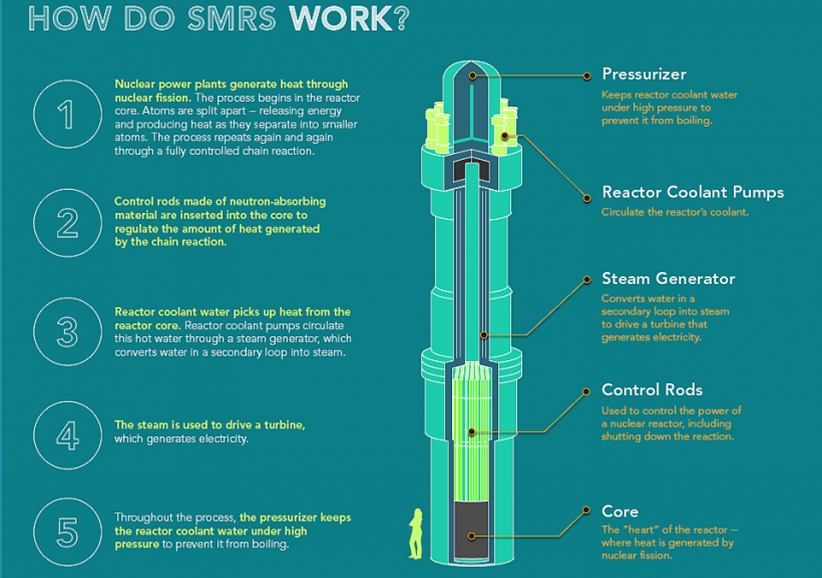
Modern nuclear systems are becoming smaller, more compact, and more efficient. Small Modular Reactors, research reactors, and advanced fuel cycles all operate with higher neutron flux densities in tighter spaces.
In such environments, neutron leakage is a critical safety concern.
Concrete alone struggles to address this efficiently. Adding more concrete increases weight and footprint, undermining modularity. Lead adds toxicity without solving neutron attenuation.
Boron provides a way forward. It enables targeted neutron control without compromising design goals.
This is why boron is becoming central to next-generation nuclear safety standards.
Beyond Reactors: Boron in Medical and Research Applications
Boron’s importance extends well beyond power generation.
In medical radiation therapy and diagnostic imaging, boron-based shielding helps protect staff and sensitive equipment from stray neutron exposure. In research laboratories, boron-loaded materials are used around beamlines, detectors, and experimental enclosures.
In aerospace and defense, boron plays a role in protecting electronics and personnel from cosmic and secondary radiation.
Across all these fields, the pattern is the same. Where neutron radiation is present, boron is essential.
BRI’s Approach to Boron-Based Shielding
At Boron Rubbers India (BRI), boron is not an additive. It is the foundation of our expertise.
For more than three decades, we have focused on developing boron-loaded elastomeric and polymer-based shielding materials that balance radiation performance with real-world usability.
Our materials are engineered to:
Absorb thermal neutrons efficiently
Integrate seamlessly into modular designs
Remain flexible, machinable, and durable
Avoid toxicity and complex handling requirements
Perform reliably under prolonged radiation exposure
These solutions are tested in radiation laboratories and trusted by nuclear agencies, research institutions, and medical facilities worldwide.
From Mass to Precision
The future of radiation protection is not about thicker walls. It is about smarter materials.
Boron represents a shift from mass-based shielding to interaction-based shielding. Instead of trying to overpower radiation, boron neutralizes it at the atomic level.
For engineers and scientists designing next-generation systems, this distinction is critical. It allows safety to scale alongside innovation rather than restrain it.
Conclusion: The Quiet Element That Makes Safety Possible
Boron rarely appears in headlines. It does not dominate skylines like concrete domes or command attention like steel structures.
Yet without boron, modern radiation protection would be incomplete.
It is the silent workhorse that absorbs neutrons, stabilizes systems, and enables compact, efficient designs across nuclear, medical, and research environments.
At Boron Rubbers India, we believe true safety lies in understanding the invisible. By mastering boron-based shielding, we help engineers and institutions build systems that are not only powerful, but responsibly protected.
Boron may be unsung. But in radiation protection, it is indispensable.


Comments