SMRs in 2026: The Global Shift That Is Redefining Energy Security


The nuclear conversation in 2026 is no longer about whether Small Modular Reactors will matter.
It is about how quickly they can be deployed.
Across Europe, North America, and Asia, governments are accelerating regulatory approvals, funding modular reactor programs, and restructuring energy policies to support compact nuclear systems. The reason is clear. The world needs reliable, low-carbon energy that can be deployed faster than traditional nuclear plants.
Small Modular Reactors, or SMRs, are emerging as the strategic answer.
The Global Energy Reality in 2026
Energy security has become a geopolitical priority. Supply chain disruptions, regional conflicts, and volatile fossil fuel prices have forced nations to rethink centralized power models.
At the same time, climate commitments are tightening. Countries aiming for net-zero emissions by 2050 are under pressure to scale clean energy rapidly.
Renewables are expanding, but they are intermittent.
Solar and wind require dependable baseload support. That is where SMRs enter the picture.
In 2026, several global shifts are shaping the SMR landscape:
Europe is prioritizing modular reactors to reduce reliance on imported gas.
The United Kingdom is advancing factory-based SMR production models.
The United States continues regulatory approvals and early deployment planning.
India is accelerating compact reactor research through BARC and associated institutions.
Eastern Europe is exploring SMRs for district heating and industrial decarbonization.
This is not experimentation. It is infrastructure planning.
Why SMRs Fit the 2026 Moment
Traditional nuclear plants are powerful but slow to build. Construction timelines can stretch beyond a decade. Capital requirements are massive.
SMRs change the equation.
They are designed for:
Factory manufacturing instead of on-site mega construction.
Modular expansion where additional units can be added gradually.
Lower upfront capital commitment.
Passive safety systems that reduce operational complexity.
Deployment in remote or industrial locations.
In a world that values speed, adaptability, and distributed power systems, SMRs align perfectly.
The global shift in 2026 is not just technological. It is philosophical. Energy systems are moving from centralized and rigid to modular and resilient.
Safety as a Strategic Advantage
Safety remains the defining factor in nuclear adoption.
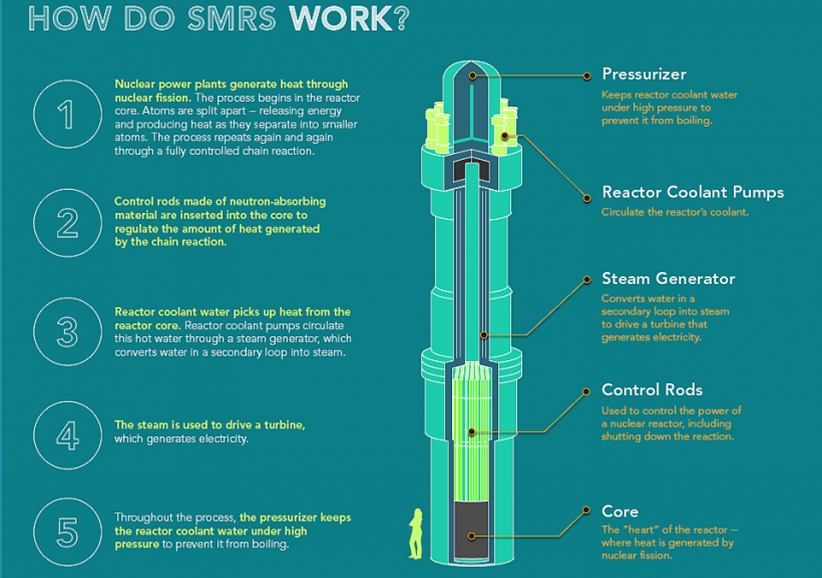
SMRs are built around passive safety mechanisms. Instead of relying on complex active systems, they use natural circulation and gravity-based cooling. Many designs operate at lower pressures and contain smaller fuel inventories.
This reduces risk profiles significantly.
For policymakers and investors, safety is not only an engineering feature. It is a confidence factor. The more inherently safe the system, the easier it becomes to gain regulatory and public acceptance.
In 2026, that confidence is becoming critical as countries expand nuclear portfolios.
The Shielding Challenge in Compact Reactors
As reactors become smaller, neutron and gamma flux densities become more concentrated within compact geometries.
This creates a new engineering requirement.
Shielding can no longer rely purely on massive concrete barriers. Modular systems demand lighter, more efficient materials that can be integrated into compact designs without compromising mobility.
Key requirements in 2026 include:
Efficient neutron absorption in smaller volumes.
Reduced structural weight for transportable modules.
Replaceable shielding systems for easier maintenance.
Non-toxic materials aligned with environmental regulations.
Traditional shielding methods struggle to meet all these criteria simultaneously.
Boron’s Expanding Role in the SMR Era
As neutron management becomes central to compact reactor safety, boron-based materials are gaining prominence.
Boron is uniquely effective at capturing thermal neutrons. When integrated into elastomeric or polymer systems, it enables:
Lightweight shielding panels.
Dual protection against neutron and gamma radiation.
Modular installation compatible with factory-built systems.
Reduced dependence on heavy metals such as lead.
For SMR developers in 2026, material efficiency is as important as reactor efficiency.
This is where advanced boron-elastomer composites become strategically relevant.
BRI’s Position in the 2026 Shift
At Boron Rubbers India, our focus has always been on practical radiation protection that aligns with evolving nuclear technologies.
For over three decades, we have developed boron-loaded elastomeric solutions engineered for:
High neutron attenuation.
Lightweight structural integration.
Modular installation.
Long-term radiation durability.
As global SMR programs accelerate, shielding is no longer an afterthought. It is part of the design conversation from the beginning.
BRI materials are already trusted in nuclear research facilities, medical applications, and radiation laboratories. The same principles now extend into the SMR ecosystem, where every kilogram and every square meter matter.
Investment, Industry, and the 2026 Outlook
The financial landscape around SMRs is also shifting.
Governments are offering loan guarantees and tax incentives. Private investors are entering the nuclear space for the first time in decades. Industrial users are exploring SMRs for hydrogen production, desalination, and high-temperature process heat.
In this environment, infrastructure decisions must consider:
Long-term lifecycle cost.
Material sustainability.
Compliance with evolving international safety standards.
Rapid deployment capability.
Shielding solutions that are adaptable, efficient, and regulation-friendly will be essential.
A Defining Moment for Nuclear Innovation
The year 2026 represents a pivot point.
Nuclear energy is no longer positioned only as a large-scale national project. It is becoming modular, distributed, and integrated into broader clean energy strategies.
SMRs are at the center of this transformation.
And as reactor design evolves, so must the materials that protect them.
At Boron Rubbers India, we believe that shielding innovation will quietly define how successful this global shift becomes. Concrete built the first century of nuclear power. The next century will rely on intelligent materials that match the speed and precision of modular systems.
The SMR era is not coming. It is already here.
The question is whether infrastructure, policy, and material science are ready to move at the same pace.


Comments