Inside SMRs: How Modular Design is Redefining Nuclear Safety

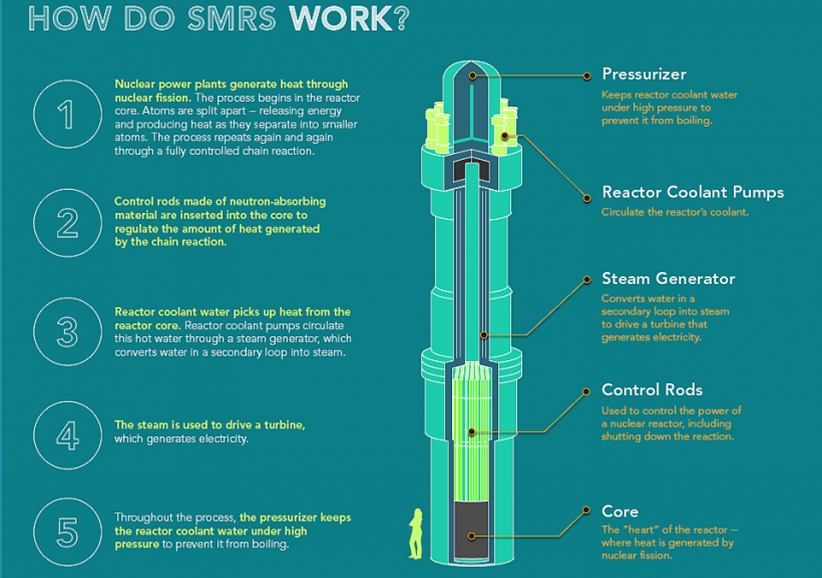
For decades, nuclear energy has stood as both a promise and a puzzle. It offers unmatched efficiency and near-zero carbon emissions, yet traditional reactors have often been defined by size, complexity, and long construction timelines.
The emergence of Small Modular Reactors (SMRs) is changing that story. Compact, factory-built, and inherently safer, SMRs are transforming how we think about nuclear safety, scalability, and sustainability.
The Shift from Monoliths to Modules
In the past, nuclear plants were colossal. They spanned vast sites, took over a decade to build, and required billions in investment.
SMRs take a completely different approach. Instead of building massive reactors on-site, they are designed as modular units, manufactured in factories, transported by road or rail, and assembled where needed.
This modular philosophy brings a new era of efficiency and precision:
Construction times reduced to 3 to 4 years instead of 10 or more
Lower capital risk due to smaller project size
Scalable output by adding modules as demand grows
Higher safety margins through standardized, pre-tested components
SMRs represent nuclear power that fits modern needs: smaller, faster, cleaner, and safer.
Safety by Design, Not by Reaction
Traditional reactors rely heavily on active safety systems. Pumps, valves, and external power sources are needed to maintain stability.
SMRs reverse that logic. They are built on passive safety principles where the laws of nature handle emergency responses. Gravity, natural circulation, and convection replace mechanical intervention.
If power fails, many SMRs can cool themselves without operator action or external electricity. Some designs are built underground or underwater, naturally shielded from external threats like earthquakes or sabotage.
Smaller fuel volumes and lower operating pressures further reduce risk. The outcome is a reactor that prevents incidents by design, rather than controlling them after they start.
Why Modularity Matters
In large nuclear plants, size itself becomes the challenge. The bigger the reactor, the greater the complexity, the harder it is to manage containment.
SMRs take the opposite route: divide and control. Each module is a self-contained power unit.
This design enables:
Localized containment, minimizing the potential impact of any single fault
Easier maintenance, as one module can be shut down while others operate
Scalable deployment, allowing utilities to add modules as needed
Improved resilience, since risks are isolated, not system-wide
In short, modularity transforms nuclear power from a single massive system into a series of controllable, safe, and efficient units.
The Global Race Toward SMRs
Across the world, countries are racing to bring modular reactors to market.
Rolls-Royce (UK) is developing a 470 MWe SMR, focused on factory-based production and reduced capital cost.
NuScale Power (USA) has secured certification for its 50 MWe reactor, a key regulatory milestone.
Russia’s Akademik Lomonosov already operates a floating SMR plant supplying power to remote Arctic regions.
India’s BARC and NPCIL are developing compact reactors tailored to industrial and regional energy needs.
This shift signals a clear message: the future of nuclear power is modular, mobile, and safe by default.
Rethinking Shielding for the Modular Age
While much attention focuses on reactor design, shielding remains a critical part of nuclear safety.
In traditional plants, concrete and lead have long been the materials of choice. They provide density and strength but pose challenges in the modular era.
Concrete adds excessive weight and slows installation. Lead, while effective against gamma radiation, is toxic and less capable of neutron absorption.
SMRs require shielding that is:
Lightweight and easy to transport
Effective across both neutron and gamma radiation
Modular and replaceable
Safe to handle and environmentally compliant
This is where boron-elastomeric composites redefine the equation.
The BRI Advantage: Smart Shielding for Smart Reactors
At Boron Rubbers India (BRI), we have spent more than three decades innovating with materials that combine science, safety, and practicality.
Our boron-loaded rubber composites are designed to meet the demands of SMR shielding. They offer dual protection from neutron and gamma radiation, are flexible for installation, and safe for long-term use.
Requirement | SMR Challenge | BRI Solution |
Weight Reduction | Heavy materials hinder mobility | Lightweight boron elastomers cut shielding mass by up to 60% |
Multi-Radiation Protection | SMRs emit both neutron and gamma flux | Boron captures neutrons, while fillers handle gamma attenuation |
Installation & Modularity | On-site casting impractical | Pre-fabricated sheets and panels, easy to assemble or replace |
Safety & Sustainability | Lead toxicity, disposal issues | Non-toxic, recyclable composites with long service life |
These materials aren’t theoretical, they’ve been tested in radiation environments and used in nuclear research labs, medical accelerators, and defense applications.
In SMRs, where every kilogram counts, this combination of efficiency, safety, and adaptability is a game changer.
Beyond Engineering: Economic and Environmental Gains
Modular design doesn’t just enhance safety, it improves economics.Smaller, faster-to-build plants reduce financing risk and accelerate returns.
SMRs can also be deployed alongside renewables, providing consistent baseload power to stabilize grids with high solar and wind penetration.
And with boron-based shielding, waste management becomes simpler. There are no heavy metal contaminants or complex disposal concerns, aligning SMR technology with the world’s sustainability goals.
This is nuclear innovation designed not just for power, but for permanence.
The Future of Safety is Precision
The evolution from traditional reactors to SMRs mirrors a shift from bulk to intelligence. Safety is no longer about massive containment walls. It’s about smart engineering, compact systems that regulate themselves, adapt quickly, and protect by design.
At Boron Rubbers India, we believe shielding should evolve at the same pace.Our boron-elastomeric solutions are more than materials. They are enablers of progress, helping make nuclear energy cleaner, faster to deploy, and fundamentally safer.
Conclusion: The Compact Revolution
Small Modular Reactors are not just smaller versions of big plants. They are a complete reimagination of how nuclear energy can serve modern society.
They merge safety with scalability, efficiency with adaptability, and innovation with environmental responsibility.
And as this new generation of reactors powers the path to clean energy, the materials that protect them will define their future.
At Boron Rubbers India, we’re proud to be part of that story, building radiation shielding that moves as fast as innovation itself.



Comments