SMRs vs Traditional Reactors: The New Blueprint for Safer Nuclear Energy


For decades, nuclear energy has been a paradox, a clean and powerful energy source often weighed down by concerns about cost, safety, and complexity.
Traditional nuclear reactors, with their vast containment domes and multi-billion-dollar price tags, shaped the world’s view of nuclear power as something monumental, permanent, and rigid.
But today, that image is being rewritten.
Enter the Small Modular Reactor (SMR), a new class of reactors that are compact, factory-built, and designed for modern safety and scalability. As nations race toward net-zero goals, SMRs are becoming the blueprint for a smarter, safer, and more adaptable nuclear future.
Traditional Reactors: Built for Scale, Not Speed
Conventional nuclear power plants were engineered during an era when bigger meant better. Their purpose was to generate massive amounts of electricity from a single site, powering entire cities through centralized grids.
These reactors typically produce 1,000 to 1,600 megawatts (MWe) per unit. While that scale offers efficiency in output, it also brings several long-standing challenges:
Aspect | Traditional Reactors |
Construction Time | 8–12 years, often with cost overruns |
Capital Cost | Billions of dollars in upfront investment |
Footprint | Large land and water requirements |
Safety Systems | Complex, multi-layered active systems |
Flexibility | Fixed power output; not easily scalable |
Decommissioning | Expensive, time-consuming, and site-specific |
Traditional reactors rely heavily on active safety mechanisms, pumps, valves, and emergency power systems that need constant maintenance and human oversight. While proven effective, these systems add to both cost and complexity.
Moreover, traditional reactors are not easily adaptable to decentralized energy grids, nor do they fit into smaller industrial or remote applications where power demand is limited.
SMRs: Small in Size, Big on Innovation
SMRs redefine nuclear power from the ground up.They produce between 50 to 500 megawatts (MWe) roughly one-third of a conventional plant’s capacity, but with drastically improved economics and flexibility.
The key lies in modularity. Instead of constructing massive structures on-site, SMRs are manufactured as pre-fabricated units in controlled factory environments and then transported for installation.
This modular approach offers several advantages:
Reduced Construction Time: Build times shrink from years to months.
Lower Capital Risk: Smaller units mean incremental investment instead of a single, massive outlay.
Scalability: Additional modules can be added as demand grows.
Enhanced Safety: Passive systems and lower operating pressures reduce accident risk.
Global Deployability: Their compact design makes them suitable for remote regions and smaller grids.
SMRs aren’t just smaller reactors, they represent a complete redesign of nuclear philosophy, focusing on practicality, sustainability, and safety.
Safety: The Core Difference
Safety has always been the heart of the nuclear debate.
Traditional reactors depend on active safety systems, engineered redundancies that respond when something goes wrong.
These systems work, but they rely on power and precision. If external electricity fails, additional emergency measures are required to prevent overheating or radiation release.
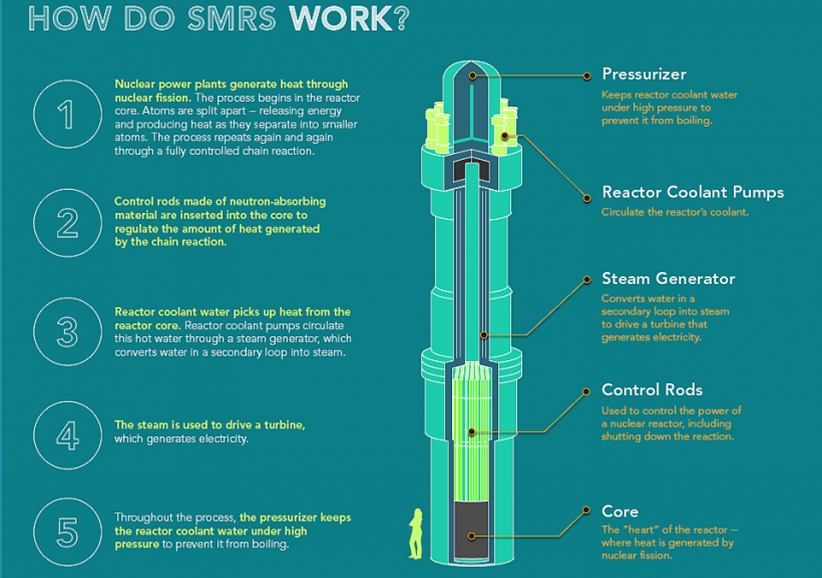
SMRs, on the other hand, use passive safety, design features that leverage natural physical laws like gravity and convection.
For example:
Passive cooling allows the reactor to remove heat without external pumps.
Low-pressure systems reduce the risk of leaks or explosions.
Smaller fuel inventories limit potential radioactive release.
Underground containment enhances resistance to natural or external threats.
The result is a system that doesn’t just react to emergencies, it prevents them.
In safety terms, SMRs mark a shift from control to containment-by-design, the same way aircraft safety evolved from reactionary systems to inherently stable design.
Economic Edge and Deployment Speed
Nuclear projects historically struggled with high capital costs and long development timelines, deterring many nations from investing in new reactors.
SMRs flip that model.
Their factory-built standardization allows serial production, reducing cost per unit over time, much like the aviation or automotive industry.
They can also be deployed gradually. Instead of committing to a 1,500 MWe plant upfront, utilities can start with a 150 MWe SMR, add modules as demand grows, and maintain continuous power output during expansion.
This flexibility gives SMRs a decisive edge in emerging markets, industrial parks, and even regions with limited grid infrastructure.
Environmental and Strategic Impact
SMRs are not just efficient, they’re also environmentally strategic.
By integrating with renewables like solar and wind, SMRs act as baseload stabilizers, ensuring reliable energy supply even when weather conditions fluctuate.
Their smaller footprint minimizes land use, and their modular structure enables faster decommissioning and recycling of components.
For countries with older reactors nearing retirement, SMRs provide a seamless transition to a cleaner and more maintainable nuclear fleet.
Moreover, their mobility allows deployment in remote areas, islands, and defense applications, enabling localized power generation without massive transmission infrastructure.
The Shielding Factor: Modern Safety Needs Modern Materials
Behind every safe nuclear system lies an equally important layer, radiation shielding.
Traditional reactors relied on thick concrete and lead barriers to contain radiation. While effective, these materials are heavy, difficult to modify, and poorly suited for modular systems.
Modern SMRs demand lighter, modular shielding solutions that match their flexible design ethos. This is where material science meets nuclear engineering.
At Boron Rubbers India (BRI), we specialize in boron-loaded elastomeric composites — advanced rubber-based materials that combine strength, flexibility, and exceptional radiation attenuation.
Shielding Challenge | BRI Solution |
Excess weight of concrete | Lightweight boron-elastomer panels, 60% lighter |
Neutron + gamma radiation | Dual-spectrum absorption with boron and heavy fillers |
Maintenance difficulty | Modular, replaceable sheets |
Toxic materials like lead | Non-toxic, recyclable, boron-based composites |
Our materials are trusted by nuclear facilities, research laboratories, and medical centers worldwide, providing protection where precision matters most.
SMRs and the Future of Nuclear Safety
SMRs aren’t just smaller versions of reactors, they’re smarter versions of safety.
They bring nuclear power into a new age of design thinking, one defined by:
Standardization over customization
Passive over active safety
Modularity over monoliths
Smart materials over brute mass
And as the world races toward net-zero emissions, SMRs will be central to the clean energy portfolio, providing dependable, scalable power that bridges the gap between renewables and reliability.
At Boron Rubbers India, we’re proud to contribute to this transformation, crafting shielding solutions that make the nuclear promise safer, faster, and more sustainable.
Conclusion: The Blueprint of the Future
Traditional reactors built the nuclear industry’s foundation. SMRs are building its future.
They redefine not just how power is generated, but how safety is engineered. Compact, efficient, and resilient, SMRs embody the evolution of nuclear design, and the materials that protect them, like BRI’s boron-elastomeric composites, are part of that new blueprint.
The next era of nuclear energy won’t be defined by size. It will be defined by intelligence, adaptability, and trust in design.

Comments