


Latest News And Update
- Page 1


Blogs
- Page 1

SMRs in 2026: The Global Shift That Is Redefining Energy Security
The nuclear conversation in 2026 is no longer about whether Small Modular Reactors will matter. It is about how quickly they can be deployed. Across Europe, North America, and Asia , governments are accelerating regulatory approvals, funding modular reactor programs, and restructuring energy policies to support compact nuclear systems. The reason is clear. The world needs reliable, low-carbon energy that can be deployed faster than traditional nuclear plants. Small Modular Reactors , or SMRs...

Boron: The Unsung Hero of Radiation Protection
Radiation protection is often discussed in terms of thick walls, dense metals, and heavy shielding. Concrete. Lead. Steel . These materials dominate most conversations because they are visible, familiar, and historically proven. Yet, behind the scenes of modern radiation safety lies a quieter hero. One that does not rely on mass alone, but on atomic precision. That element is boron . Across nuclear reactors, medical accelerators, research laboratories, and even aerospace systems, boron plays...

SMRs vs Traditional Reactors: The New Blueprint for Safer Nuclear Energy
For decades, nuclear energy has been a paradox, a clean and powerful energy source often weighed down by concerns about cost, safety, and complexity. Traditional nuclear reactors, with their vast containment domes and multi-billion-dollar price tags, shaped the world’s view of nuclear power as something monumental, permanent, and rigid. But today, that image is being rewritten. Enter the Small Modular Reactor (SMR) , a new class of reactors that are compact, factory-built, and designed for...
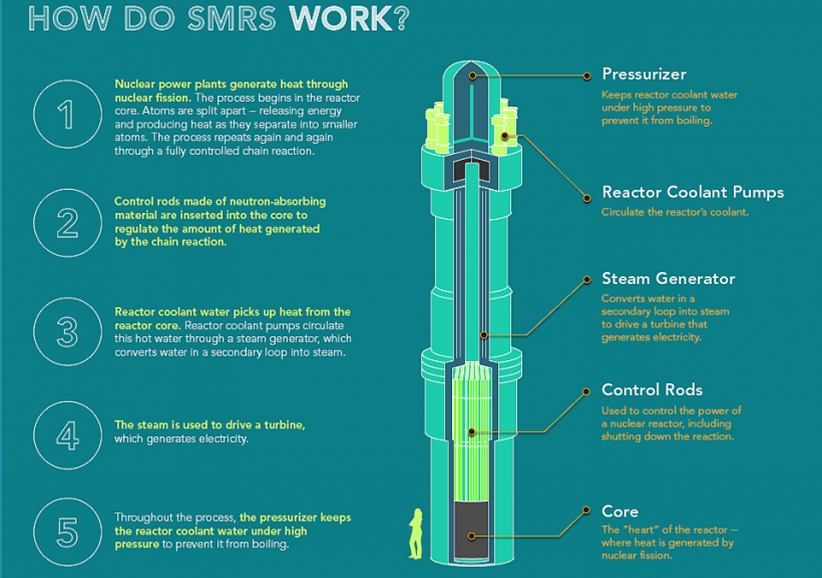
Inside SMRs: How Modular Design is Redefining Nuclear Safety
For decades, nuclear energy has stood as both a promise and a puzzle. It offers unmatched efficiency and near-zero carbon emissions, yet traditional reactors have often been defined by size, complexity, and long construction timelines. The emergence of Small Modular Reactors (SMRs) is changing that story. Compact, factory-built, and inherently safer, SMRs are transforming how we think about nuclear safety, scalability, and sustainability. The Shift from Monoliths to Modules In the past,...

Why Concrete Can’t Keep Up with the Next Generation of Reactors?
For decades, concrete has been synonymous with nuclear safety.From the first power reactors of the 1950s to the massive containment domes that still dominate skylines today, concrete became the material that stood between humans and radiation, a symbol of strength, stability, and permanence. But as the nuclear industry transitions toward Small Modular Reactors (SMRs) and advanced compact systems , this once unshakable foundation is showing its cracks, not in durability, but in relevance . ...

How Boron Works: A Simple Guide to Moderation, Capture, and Gamma Control
Walk through a nuclear plant, a cyclotron bunker, or a neutron research lab, and you will find the same quiet material appearing in blocks, sheets, and granules: boron. It lacks the visual drama of lead and the mass of concrete, but ask any Radiation Safety Officer and they will tell you that boron is indispensable. Its strength lies in a three-part sequence that no other material delivers so elegantly: hydrogen-rich moderation, high-probability capture, and manageable gamma control. That...

Concrete, Lead, or Boron-Elastomer? Shielding Choices for Modern SMRs
In the world of nuclear power, shielding has always been treated as something you build around the reactor after the design is done. For decades, two metres of concrete were enough to protect workers and satisfy regulators. But Small Modular Reactors are rewriting the rules. These reactors are meant to be compact, mobile, and deployable in places where conventional plants would never fit. They need to travel by truck, ship, or barge, and sit on limited real estate. That makes shielding not...

From Sprint To Stroll: The Materials That Tame Fast Neutrons
How RSOs turn 14‑MeV sprinters into docile, capture‑ready particles, without pouring another cubic metre of concrete. Why “Thermalising” Is the RSO’s Secret Super‑Power A 5 MeV neutron slices through stainless steel like a ghost. Slow it to 0.025 eV and the same particle becomes sticky, eager to be captured by boron or cadmium before it ever meets human tissue. Thermalisation isn’t just good physics; it’s the cheapest way to slash dose, activation, and regulatory headaches in one move. Yet...